Best Affiliate Marketing ProgramsHow to Start Affiliate Marketing with No Money: 6 Steps to Your First Program
How to Start Affiliate Marketing with No Money: 6 Steps to Your First Program
The short answer
You can start affiliate marketing with no money by choosing a niche you understand, publishing content on a free platform such as a blog, YouTube, or social media, and joining a free affiliate program that fits your topic. You earn a commission when someone buys through your link. The real cost is time, and first commissions usually take weeks or months of steady publishing.
Some links on this site are affiliate links: if you buy through one, the site may earn a commission at no extra cost to you. More about this.
By the end of this guide, you will have a working starting point: one niche, one free platform, and one affiliate program you have checked and applied to. You will also know what to look for before you sign up anywhere.
Most of the steps are about avoiding common early mistakes. Programs that pay little or nothing, approval rules that catch beginners off guard, and paid courses that promise more than they deliver all cost new affiliates time they cannot easily get back. This guide covers six steps in order, with plain checks you can run yourself.
Along the way, we explain how the programs in this review were chosen, so you can see what the picks are based on and what is not yet known.
You will finish able to pick a niche, set up a free publishing space, find and join a suitable program, and publish your first piece of content with a link you can track.
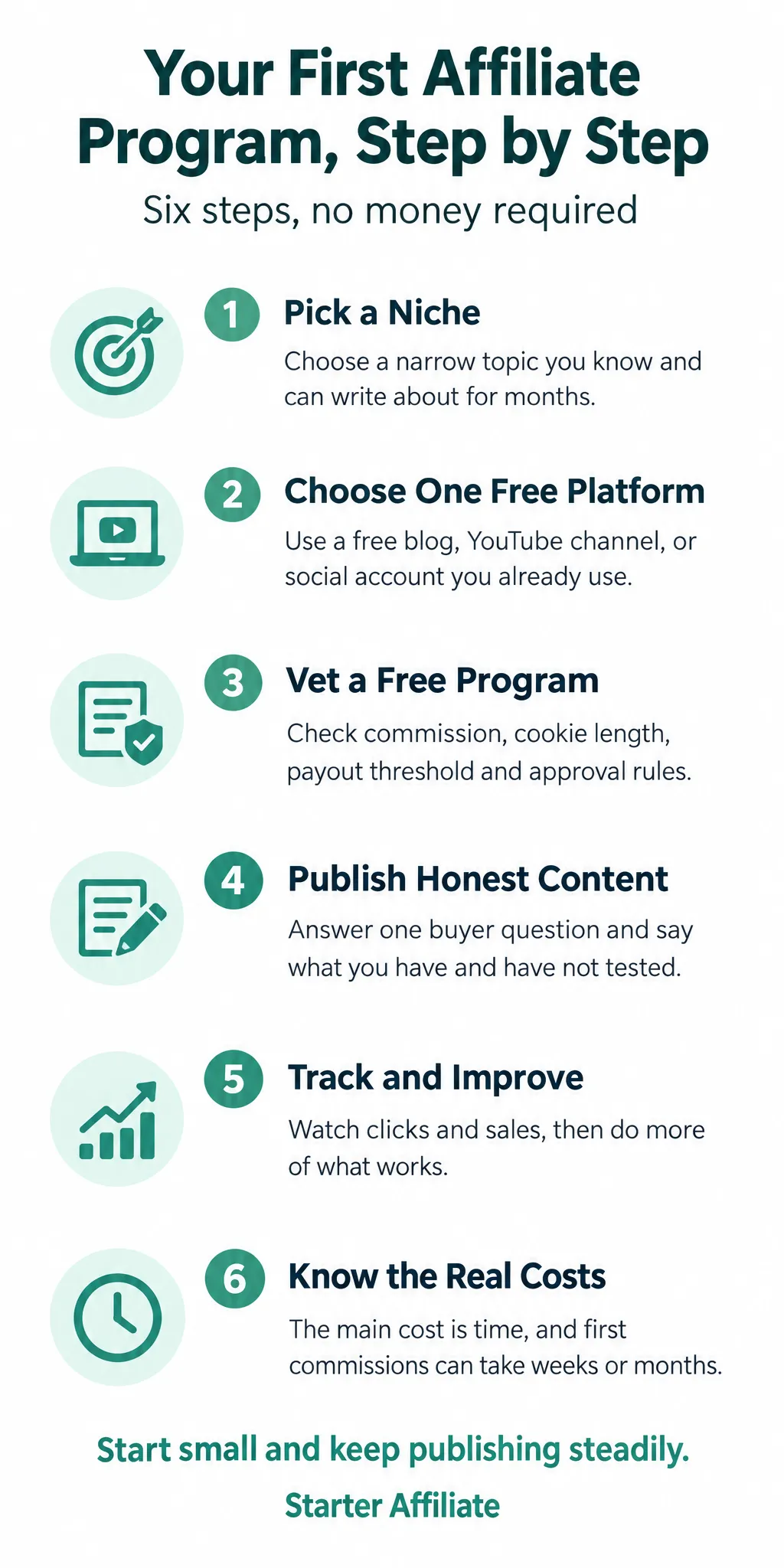
Quick steps:
- Pick a Niche You Can Write About for Months
- Choose One Free Platform to Publish On
- Find and Vet Your First Free Affiliate Program
- Publish Honest Content That Answers a Buyer's Question
- Track Clicks and Sales, Then Improve What Works
- Know the Real Costs and Decide on Next Steps
Step 1: Pick a Niche You Can Write About for Months
Your niche is the narrow topic your content and recommendations will focus on. Pick it first, because every program, product and piece of content you create after this depends on it. Get it right and the rest of the work gets easier. Get it wrong and you may spend months writing about something you dislike.
Start with what you already know or follow. You will write about this topic often, so choose something you can keep talking about without running out of ideas. A hobby, a job you have held, a sport you play or a gadget you use every day all work well. If you have no clear favorite yet, pick the area you read about most.
Next, check that people actually buy products in that area. Search Google for the topic plus "best," "review" or "vs." For example, search "best budget running shoes for flat feet" or "trail camera review." If you see many comparison posts, shopping guides and video reviews, buyers are looking for recommendations there. If you find almost nothing, the market may be too small.
Then narrow the topic until you can name one specific buyer. "Shoes" is too broad. "Budget running shoes for flat feet" tells you exactly who you are writing for and what they want. A narrow niche is easier to rank for and easier to build a loyal audience around.
Avoid two kinds of topics:
- Areas where every product page is pay-only or where programs pay nothing.
- Areas so crowded with big sites that a beginner has little chance of being seen.
Your simple checklist:
- I know this topic or follow it regularly.
- I can find reviews and comparison posts about it.
- I can describe one specific buyer in a single sentence.
- Programs in this area pay a commission I can check.
[screenshot: a Google search results page for "best budget running shoes for flat feet" showing comparison posts and shopping guides]
Step 2: Choose One Free Platform to Publish On
Before you can recommend anything, you need a place to publish. The good news is that you can set one up for free. You do not need a paid domain, a hosting plan, or a course to get started.
Here are the free options most beginners use:
- A blog on a free blogging service. Platforms such as Blogger or WordPress.com let you publish articles without paying for hosting. Your address will look like yourname.blogspot.com or yourname.wordpress.com.
- A YouTube channel. YouTube is free to join, and it works well for product demos, comparisons, and tutorials. You can create a channel from your Google account.
- A social account you already use. If you already post on Instagram, TikTok, or Pinterest, you can start there. Pick the one where your interests already fit.
Choose the format you can keep up with each week. A blog post every week is more useful than a video series you abandon after two uploads. Consistency matters more than the platform you pick.
Use one platform first. Adding more before the first one works splits your time and makes it hard to tell what is working. You can expand later.
For example, say you enjoy making short cooking videos. YouTube is a natural fit for you, so you create a free channel, post one video a week, and add product links to the description.
Once you have your platform set up, check these items:
- Account created and profile filled in with a short description of what you cover
- First piece of content planned for this week
- Posting schedule written down
[screenshot: a new blog dashboard or YouTube channel setup page with the profile and description fields visible]
A free blog address is fine for testing. If your idea holds up after a few months, you can buy a custom domain later.
Free publishing platforms compared
| Platform | Good fit for | Address format |
|---|---|---|
| Free blogging service | Written articles and comparisons | yourname.blogspot.com or yourname.wordpress.com |
| YouTube channel | Product demos, comparisons, tutorials | Channel created from your Google account |
| Existing social account | Audiences you already reach | Your current account profile |
Step 3: Find and Vet Your First Free Affiliate Program
Your first program should be free to join, match what you already plan to write about, and pay in a way you can actually reach. This step is about narrowing the field and checking the details before you apply.
Start with the networks and direct programs that fit your niche. Some common places to look:
- Amazon Associates: open to most people, pays on a wide range of products, but has strict sales rules.
- ShareASale, CJ Affiliate: networks that host many merchants in one dashboard.
- ClickBank: a marketplace of digital products, with its own terms you should read closely.
Pick two or three that carry products your audience would buy. Then open each program's own terms page. Don't rely on a summary somewhere else.
For each program, write down:
- The commission rate, and whether it is a flat amount or a percentage
- The cookie length, meaning how long after a click you still earn a sale
- The payout threshold, the minimum balance before you get paid
- The approval requirements, such as a minimum traffic level or a live site
[screenshot: a program's terms page with commission, cookie length and payout threshold highlighted]
Be wary of any program that charges a fee to join, promises guaranteed income, or won't show its commission terms before you sign up. Walk away from those.
Expect some rejections, especially if your site has only a few pages. That is normal. If you are turned down, add more useful content, then apply again later, or try a different program. A rejection tells you the program wants more substance, not that you have failed.
Affiliate program terms to record
| Term | What it tells you | Where to find it |
|---|---|---|
| Commission rate | How much you earn per sale | Program's own terms page |
| Cookie length | How long after a click a sale still counts | Program's own terms page |
| Payout threshold | Minimum balance before you get paid | Program's own terms page |
| Approval requirements | What your site needs before you are accepted | Program's own terms page |
Step 4: Publish Honest Content That Answers a Buyer's Question
This is where affiliate marketing starts to work. You are not selling anything yet. You are answering a question that someone already has, and the affiliate link is just one useful resource in that answer.
Pick one question your audience is asking. Good starting formats are a comparison ("Notebook A vs. Notebook B for students"), a how-to ("How I set up a home desk for under a hundred dollars"), or a "best for" guide ("Best budget headphones for a small apartment"). Search Google for the phrase and read the top results. Note what they cover and what they skip.
Then write or film the piece. Keep it to one clear topic. Explain what you have used, what you have only read about, and what you have not tested at all. If you have not tried a product, say so. Readers trust that more than a glowing claim you cannot back up.
Place links where they help. Put the link next to the spot where a reader would want to buy, not in a wall of links at the top. Use the link text that describes the product, not "click here."
Add a clear disclosure near the top, before any links. Use plain words such as "I earn a commission if you buy through my links at no extra cost to you." Check the program's rules for exact wording and placement, and follow the FTC guidance for disclosures.
Aim for two or three strong pieces before you publish anything else. One well-researched comparison will do more for you than ten thin posts.
[screenshot: example article outline with the question as the title, a disclosure line under the intro, and one link placed beside a product description]
Step 5: Track Clicks and Sales, Then Improve What Works
Once your first links are live, you need to know what is happening. Which posts or videos send people to the product page? Which of those visitors actually buy? You cannot answer either question by guessing, so set up tracking from the start.
Start with what the program gives you for free. Most affiliate programs and networks provide a dashboard that shows clicks, orders, and commissions by link or tracking ID. Use a separate tracking ID or sub-ID for each page or video if the program allows it. [screenshot: a program dashboard showing clicks, orders, and commissions broken down by tracking ID]
Next, add free analytics to your own site or channel. Google Analytics is a common free option for websites. YouTube Studio shows click-through data for links in your descriptions and video performance for each upload.
Then review the numbers every few weeks:
- List your posts or videos by clicks.
- For the top ones, check how many clicks led to sales.
- Write more on the topics and products that convert, and set aside the ones that get clicks but no buyers.
For example, say you run a small cooking blog. You find that a post on budget kitchen knives gets 40 clicks and two sales, while a general post on meal prep gets 200 clicks and none. You write three more knife guides and drop the meal prep links.
Keep your old posts up to date too. Prices change, products get discontinued, and some links stop making sense. Check your highest-traffic pages every few months and fix or remove outdated links.
Finally, be patient. Early numbers are usually small, and first commissions often take weeks or months. Keep tracking and keep publishing.
Step 6: Know the Real Costs and Decide on Next Steps
Starting with no money is possible, but "no money" does not mean "no cost." The real cost is your time. You need steady hours each week to research, publish, and improve your content. Most people underestimate this, and it is the reason most beginners stop.
Here is how to check your own situation before you spend anything:
- Count your weekly hours. Write down how many hours you can give to content each week, every week, for the next few months. Be honest. Three hours you actually have beats ten you hope to find.
- Test the free setup first. Use a free platform such as a free blog, a free YouTube channel, or a social account. Publish at least 10 to 15 pieces of content before you consider paying for anything.
- Spend only when a free option is clearly holding you back. For example, you might need a custom domain once your traffic is steady, or a better microphone once your videos are getting views but the sound is the complaint. Pay for the specific fix, not for a bundle.
- Wait for evidence. Spend money only after you have some income or clear proof the approach works, such as a click-through pattern you can point to.
Be careful with paid courses and tools that promise fast results. Most of what you need, including how a program's links work and what its rules are, sits in free guides and each program's own documentation. Read those first.
Example: a reader who can give six hours a week to a free YouTube channel should start there, track how many videos get views, and reassess after three months. If the videos get no traction despite steady output, the problem is usually the niche or the content, not a missing paid tool.
If you cannot commit regular hours, the path will be slow whatever setup you choose. Decide that first.
Frequently asked questions
What is the easiest affiliate marketing method?
For most beginners, the easiest method is writing short reviews or comparison posts on a free blog or a social profile, then linking to products you have actually looked into. You need no inventory and no customer service. Pick one platform, post regularly about one topic, and add links where they fit naturally.
How to earn 1 lakh per month in digital marketing?
Earning one lakh rupees a month through affiliate work usually takes a steady audience, several products that match what that audience wants, and time to build content that keeps earning. Most beginners do not get there quickly. Start with a single niche and one program, then add more only after the first one brings in regular sales.
How many followers do I need to be an Amazon affiliate?
Amazon's Associates program does not require a set number of followers to join, but it does have approval rules tied to your site or social profile and to making qualifying sales within a set period. Check the current eligibility page on Amazon before applying, since these terms change and are covered in detail in the Amazon affiliate guide on this site.
How do I start affiliate marketing on my phone?
You can start on a phone by using a free social account, a free blog app, or a notes app to draft short posts. Create one account, pick a topic you know well, and post a few useful pieces before adding any links. Keep your disclosures visible and follow each program's rules on where links may appear.
Do I need to spend money to start affiliate marketing?
No. You can join many programs and publish on free platforms without paying anything. Some people later choose to buy a domain name, which usually costs about a few dollars or pounds a month in hosting, but this is optional at the start. Be wary of paid courses or tools that promise fast results.
Conclusion
Each of the six steps is something you can do this week without spending money.
Which step will you try first: choosing your niche, picking a free platform, or finding your first program?
Start with the step that feels least clear and work from there.
If you want to compare programs before you commit, Visit the official site and look through the options at your own pace.