Best Affiliate Marketing Programs12 Affiliate Marketing Courses Worth Your Money, and the Free Options That Cover the Same Basics
12 Affiliate Marketing Courses Worth Your Money, and the Free Options That Cover the Same Basics
The short answer
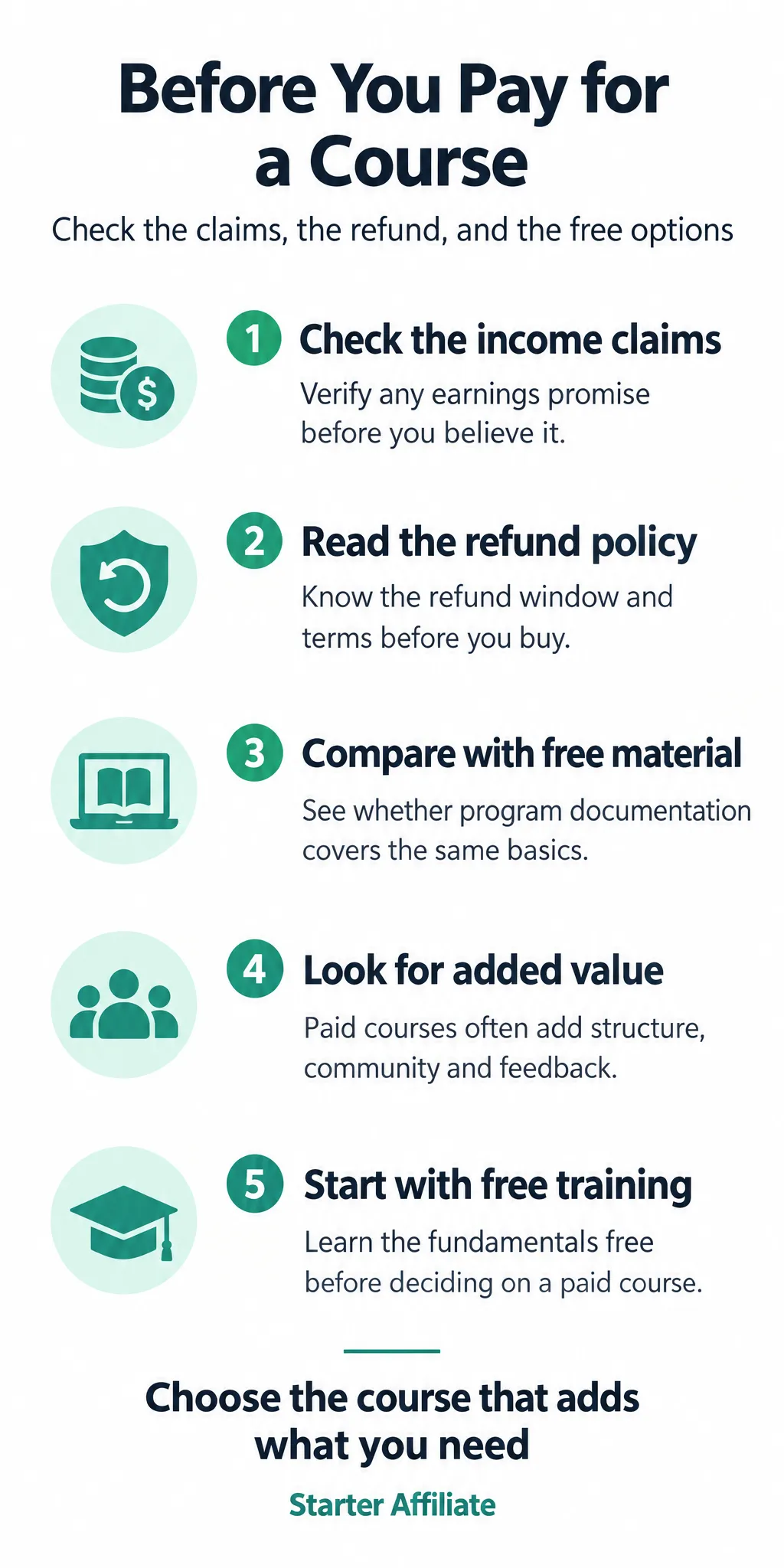
Affiliate marketing courses are worth the cost only if they teach something you cannot get free. Before paying, check the income claims against what you can verify, read the refund policy, and compare the course with free material covering the same basics, such as program documentation and free blogging platforms. Many beginners learn the core steps for nothing. Paid courses tend to add structure, community and feedback.
Some links on this site are affiliate links: if you buy through one, the site may earn a commission at no extra cost to you. More about this.
If you are trying to earn money by recommending products online, you have probably seen dozens of courses promising a clear path to income. Some are useful. Others repeat what the program websites already publish, wrapped in urgent sales pages. This guide helps you tell the difference.
We looked at 12 affiliate marketing courses and set out a simple way to judge each one. The picks were chosen by comparing what each course covers against the free basics that are already available, and by checking how each one describes its results and refunds.
Here is the approach. For every course, we ask what it teaches that you could not learn from a program's own documentation or a free blogging platform. We look at whether the income claims can be checked, and whether the refund terms are clear enough to act on. The free alternatives are listed alongside, so you can see what you would be paying for.
Let's dive in.
Paid courses compared by what they focus on
| Course | Main focus | Best for |
|---|---|---|
| Spark by ClickBank | Marketplace-based course | Beginners checking the seller first |
| The RMBC Method | Copywriting | Writing persuasive promotions |
| Commission Hero | Building an affiliate business | Choosing a niche and first offer |
| The Authority Site System | Building content sites | Review and comparison pages |
| Project 24 | Time-to-results claims | Testing stated timeframes |
| Fat Stacks Bundle | Several topics in one bundle | A broad overview |
| The Affiliate Lab | SEO-driven affiliate sites | Understanding search traffic |
| Passive Income Geek | Long-term passive income | Readers expecting slow results |
A closer look at each
Spark by ClickBank: Spark is a paid course sold through ClickBank, a marketplace that many beginners look at first. Before you buy, check who runs the course and whether the marketplace matches what you need. Read the refund terms too. Our own look at course providers starts with the seller, not the sales page. See our ClickBank Explained page for what to check before you promote its products.
The RMBC Method by Stefan Georgi: This is a paid course built around copywriting, the writing that persuades people to click and buy. Beginners often find it in affiliate roundups, so know what it teaches before you spend money. Ask whether copywriting skills suit how you plan to promote, such as through reviews, emails or ads. If the course promises quick sales, treat that as a claim to verify, not a fact.
Commission Hero by Robby Blanchard: Commission Hero is a paid course aimed at helping you build an affiliate marketing business. It appears in most top roundups, which says more about its visibility than its results. Look for specific lessons, a clear list of modules and a stated refund window before you pay. Compare it with free training that covers the same basics of choosing a niche and a first offer.
The Authority Site System and Authority Hacker Pro: This paid course focuses on building content sites, which suits beginners who plan to write product reviews and comparison pages. Content sites take time to rank in search, so be wary of any course that promises fast income. Check how much of the course is about the basics you need and how much is about tools you may not use yet.
Project 24 by Income School: Project 24 is a paid course that is often recommended to beginners. It makes time-to-results claims, so it is a good case for testing those claims. Look for the timeframe they state and ask what it assumes about your hours, traffic and niche. Then check the refund policy and whether free sources explain the same steps.
Fat Stacks Bundle by Jon Dykstra: Fat Stacks is a paid bundle of training covering several topics, useful if you want a broad overview. Bundles cover more ground but often go less deeply into each topic. List the topics you actually need, such as keyword research, content and tracking, and see whether the bundle covers them in enough depth to act on.
The Affiliate Lab by Matt Diggity: A paid course that teaches affiliate marketing through SEO-driven sites, so you learn how search traffic reaches your content and how pages earn commissions over time. It suits beginners who want to understand where visitors come from before they spend money on ads or tools.
Wealthy Affiliate: A membership platform, not a one-off course. You pay a recurring fee for training, website hosting and built-in tools in one place, so the cost is ongoing. Check the renewal price and cancellation terms before you join, since they matter more than the headline offer.
Making Sense of Affiliate Marketing School: A paid school-style course with lessons arranged in a fixed order, so you work through setup, content and promotion step by step. It fits readers who learn better with a set path and do not want to choose their own starting point.
Passive Income Geek by Morten Storgaard: A paid course built around long-term passive income, meaning sites and content that keep earning after the work is done. It fits readers who expect slow early results and want a model that compounds, rather than quick wins.
Free Affiliate Marketing Courses on Simplilearn: A free course that ends with a completion certificate, so you can show you finished the basics without spending anything. It covers the core ideas of affiliate marketing, which makes it a sensible first step before you consider any paid course.
Free Affiliate Marketing Training on Acadium: A free training option that appears in several beginner lists, offering structured lessons with no cost. It is a good place to learn the fundamentals and decide whether a paid course adds anything you cannot get from free material.
Frequently asked questions
How do you get into affiliate marketing?
Start by choosing a topic you know well and have some interest in. Then pick one or two affiliate programs in that area, sign up, and publish helpful content such as reviews, guides, or comparisons. Share it where your audience already spends time. Most beginners spend their first months learning what people search for before any sales come in.
What is the 80/20 rule in affiliate marketing?
The 80/20 rule suggests that most of your results come from a small share of your work. In practice, a small number of pages or products often bring in most of the commissions. The advice is to find those winners by checking which content gets traffic and clicks, then putting more effort into updating and promoting them.
How much do affiliate marketers make?
Earnings vary widely. Many beginners earn little or nothing for their first several months, while a small group earns a steady income from established sites. Your pay depends on the program's commission rate, the price of what you sell, how much traffic you get, and how often people buy. Treat any income claim with caution, including those made in paid courses.
Do affiliates get paid for clicks?
Usually not. Most affiliate programs pay only when a tracked action happens, most often a completed sale. Some programs pay for a lead, such as a signup or form submission. Pay-per-click programs exist but are less common. Always read the program terms to confirm exactly what earns a commission.
Wrapping up
That covers the 12 affiliate marketing courses in this guide, along with the free options that teach the same basics.
Before you pay for any course, check its claims, its refund policy, and whether a free alternative covers what you need.
Which one will you try first, or is there one I missed? Tell me in the comments.
If you want to compare the details for yourself, Visit the official site.